

Stop Reacting. Start Rewiring. Build a Learning Culture for Perpetual Readiness
- Dec 10, 2025
- 4 min read
Why This Matters More Than Ever
The future of work is no longer theoretical—it’s here!
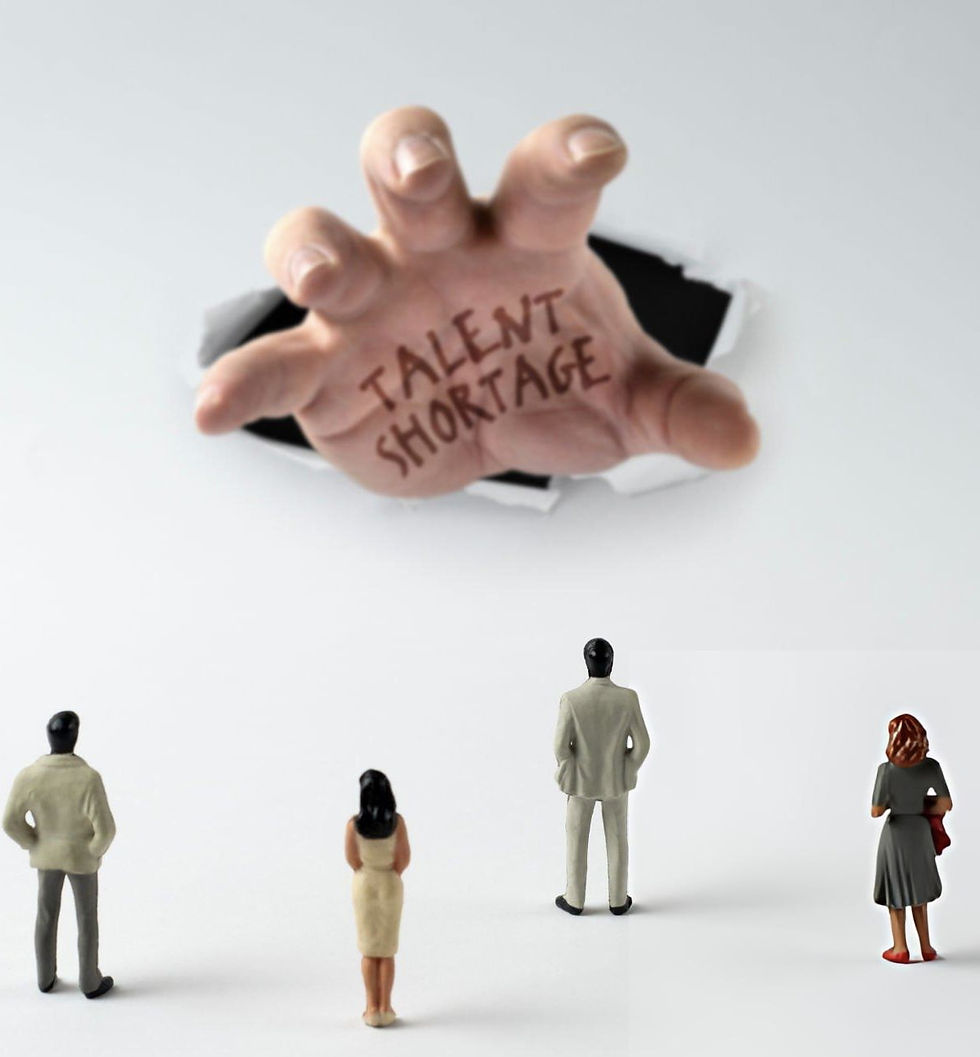
Korn Ferry projects an $8.5 trillion global talent shortage by 2030. Meanwhile, SHRM’s January 2025 Labor Market Review reinforces this concern, noting that employers across industries continue to struggle to find qualified talent.
Access to opportunity also isn’t equal. Job seekers in urban, suburban, and rural communities experience dramatically different labor market dynamics, with opportunities decreasing the farther one lives from large metropolitan areas. In many rural and some suburban areas, job turnover is far less frequent, resulting in fewer openings and slower pathways to upward mobility.
These realities raise tough questions from both macro and micro level perspectives:
What happens when employers deploy technology to transform talent without a people-strategy platform to support it?
What happens when employees want to transition careers but lack resources, training, and guidance?
Too often, we tend to be reactive rather than evolve.But reacting doesn’t build readiness.However, rewiring our approach enables us to thrive within an ever-changing workforce landscape.
TALENT: The Case for Reimagining Workforce Development
A review of job boards often reveals recurring postings for the same position, partially suggesting that employers didn’t find “the right candidate.” This raises a critical question: is the issue the talent pool, or the strategy used to engage it?
Research shows that 59% of employers would reject a candidate with a high IQ (intelligence quotient) but low EQ (emotional quotient), meaning someone is very intelligent but struggles with interpersonal skills (Safer, 2023). This highlights the importance of cultivating learning cultures that prioritize EQ. With a looming talent shortage, dismissing capable candidates due to underdeveloped EQ is both counterproductive and preventable with targeted development.
Some reasons human capital challenges persist due to a lack of effective succession planning (Tyler, 2022) include, but are not limited to:
No succession plans are in place for all positions across the organization to mitigate “single points of failure”
Insufficient talent pipelines of “ready-now” successors for critical roles
Siloed cultures where knowledge is not consistently shared or transferred
Succession planning is viewed as a one-time event rather than an ongoing, evolving process
Limited or nonexistent training programs for lateral moves and internal career growth
The consensus among experts is that a future-ready workforce requires an early, consistent, and intentional investment (Lands et al., 2025). Research also indicates that employees frequently prioritize a healthy work environment, effective leadership, and positive relationships with managers over compensation (SHRM, 2024).
Given the ongoing talent shortage, it is understandable that reimagining the workforce also requires a strategic use of technology to “do more with less,” which increases efficiency, automates tasks, and improves communication across diverse teams.
TECHNOLOGY: A Moving Target That Demands Constant Learning
Since the early dot-com era, one thing has remained true: technology evolves whether we’re ready or not.

“There’s an app for that” is now a universal truth, and artificial intelligence (AI) can be applied to nearly everything.
The real challenge isn’t technology adoption—it’s keeping up.
To build what comes next, organizations must learn from what worked in the past while navigating real-world constraints, such as time, budget, skills, technology, and access to the right people.
The learning landscape has reinvented itself repeatedly over the years (Mas, 2018):
“Show, Tell, Do, and Check” simplified complex tasks and built learner confidence through structured feedback
Kirkpatrick’s Four Levels of Training Evaluation helped organizations measure and refine training effectiveness
Bloom’s Taxonomy provided a foundation for developing clear and measurable learning objectives
Ironically, it takes technology to learn technology. Organizations cannot modernize if their employees lack the digital skills necessary to utilize new tools, and employees cannot adapt without space for continuous learning. Over time, technology has enabled learning and development (L&D) practitioners to continually evolve with how people learn, including (Mas, 2018):
Learning Management Systems (LMS) make training accessible anytime, anywhere
Adaptive learning delivers personalized training to learners at the right time
Mobile learning integrates training into daily routines
Virtual reality (VR) offers immersive, lifelike simulations for hands-on practice
Augmented reality (AR) allows learners to interact with real-time scenarios
Artificial intelligence (AI) uses as a dynamic feedback loop to assess learning as it unfolds and refine training in real time
Technology alone isn’t enough to drive change. The real differentiator is transformation: reshaping mindsets, strengthening leadership capacity, and building a culture where continuous learning becomes part of the organization’s DNA.
TRANSFORMATION: From One-Time Training to Perpetual Readiness

Even with rapid technological advancement, many organizations continue to treat learning and development as a one-time event—a workshop, a seminar, or a checkbox for compliance training (Gooding, 2025).
At the same time, upskilling and reskilling have become “more important than ever” in today’s fast-changing environment (Tyler, 2022; Maurer, 2024). Achieving a meaningful transformation requires a systems-thinking approach that aligns learning with work, strengthens employee connections, and integrates earning and development with performance in an agile environment (Gooding, 2025):
Continuous learning, not one-time training
Inclusive leadership that builds psychological safety
Roadmaps that develop soft skills from entry-level to executive
Just-in-time learning for new technologies and new roles
Train-the-trainer models to scale knowledge internally
On-the-job learning embedded into real workflows
Framing the plan is easy.Operationalizing it is the challenge.Especially when leaders lack the emotional and cognitive balance required to effectively lead people and manage tasks.
And it forces us to ask: What is the long-term cost of doing more with less?
Ready for the Next Step? CSR Can Help
If your organization is stuck reacting instead of evolving, CSR can help disrupt the status quo.
We partner with organizations to:
Build modern, adaptive workforce development strategies
Design continuous learning ecosystems
Integrate people strategy with technology strategy
Develop leadership pipelines rooted in EQ + IQ
Prepare your workforce for constant change
If you’re ready to explore human capital strategies that strengthen your talent, elevate your culture, and build perpetual readiness—CSR is here to support you.
Tony Ballard is a global human capital and talent transformation leader with a distinguished 20+ year career across the U.S. Air Force, the finance industry, and academia, currently serving as an adjunct professor. Leveraging deep expertise in organizational development, he has designed and executed enterprise-wide learning strategies, scaled mentorship programs impacting over 200,000 employees, and influenced policies for a global workforce of over 697,000. He is an expert in building leadership pipelines rooted in EQ + IQ and fostering a culture of continuous improvement.
Comments